
2026 Best Festo Pneumatic Cylinder Types for Buyers?

Selecting the right Festo Pneumatic Cylinder in 2026 requires more than comparing bore sizes and prices. Buyers must examine force, stroke, speed, mounting space, sealing materials, and operating conditions. A cylinder working beside coolant behaves differently from one moving cartons in a dry warehouse.

The market signals remain strong. The International Federation of Robotics reported 541,302 industrial robots installed worldwide in 2023, a 10% annual increase. More automated cells create steady demand for compact, repeatable pneumatic actuators. Grand View Research also identifies continued growth in the global pneumatic equipment market through 2030, supported by manufacturing, packaging, and material-handling applications.

But growth does not remove purchasing mistakes.

Festo’s product documentation emphasizes technical compatibility, service life, and application-specific selection. That practical approach matters. A low-cost cylinder may appear efficient, yet poor cushioning can cause vibration, noise, and premature seal wear. The cheapest option is not always economical.

Dr. Frank Melzer, a former Festo technology leader, described modern automation as “digital, connected, and sustainable.” That principle changes how buyers should evaluate a Festo Pneumatic Cylinder. Sensors, diagnostics, air consumption, and maintenance access now deserve attention beside mechanical performance.

This guide compares major cylinder types for 2026 buyers. It considers ISO 15552 and ISO 6432 designs, compact cylinders, guided cylinders, rodless cylinders, and application-specific options. It also highlights trade-offs that catalog tables often hide. Some recommendations remain conditional. Real loads, pressure fluctuations, installation errors, and contaminated air can change the result. Manufacturer datasheets and on-site testing should always have the final word.
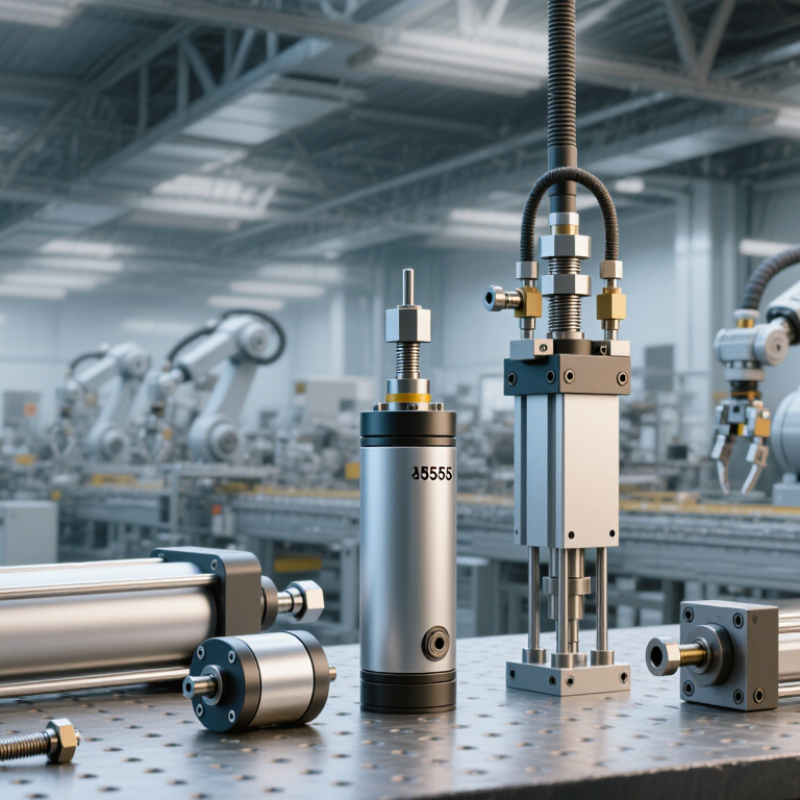
2026 Best Festo Pneumatic Cylinder Types for Buyers?

Festo Pneumatic Cylinders: Purpose, Structure, and Core Operating Principles

Pneumatic cylinders convert compressed-air energy into controlled linear motion. They push, pull, clamp, lift, or position machine parts. Their basic structure includes a barrel, piston, piston rod, seals, end caps, and air ports. Air enters one chamber and creates pressure across the piston area. Force is roughly pressure multiplied by effective area, minus friction. Stroke determines travel. Bore diameter affects available force.

Single-acting cylinders use air for one direction and a spring for return. Double-acting cylinders use air on both sides, providing better control and longer strokes.

Rodless designs save space when external guidance is available. Guided cylinders resist twisting loads, but they cannot replace a rigid machine frame. ISO 15552 and ISO 6432 dimensions support comparison, although mounting details still need inspection. A catalog match is not complete engineering.

The International Federation of Robotics reported 541,302 industrial robot installations in 2023, a 10% annual increase. This growth supports demand for repeatable pneumatic motion in packaging, assembly, and handling.

The U.S. Department of Energy notes that compressed-air leaks can waste 20% to 30% of system output. Buyers should check cycle rate, load, cushioning, air quality, and duty cycle.

A 6-bar rating does not guarantee six-bar performance at the rod. Friction, pipe losses, and misalignment intervene. Small leaks seem harmless. They are costly over time. A larger bore is not always safer; it may increase impact, cost, and air consumption. Test the real load, not only the spreadsheet.


Major Festo Cylinder Types and Their Distinctive Applications

Choosing the right pneumatic cylinder starts with motion requirements, not catalog popularity. Double-acting cylinders provide powered extension and retraction for clamps, slides, and pick-and-place systems. Single-acting models use air in one direction and a spring for return. They suit simple ejectors, stops, and light-duty positioning tasks. Compact cylinders save installation space inside crowded machines. Their shorter bodies help with tight layouts, but limited stroke and heat tolerance can affect performance.

Guided cylinders combine linear motion with external support. They work well for pushing trays, cutting fixtures, and handling uneven loads. Rodless cylinders create long strokes without a fully extended rod. This design benefits conveyor transfers and wide machine platforms. Rotary pneumatic actuators convert air pressure into angular movement. They are useful for turning grippers, valves, and small indexing tables. The required rotation angle, load inertia, and stopping accuracy need careful checking.

Field inspections often reveal the same mistake: buyers select bore size before checking side loads. That choice can shorten seal life. Measure the load, stroke, speed, mounting space, and operating pressure together. Cushioning reduces impact at the stroke ends, especially on fast cycles. Stainless materials may help in washdown areas, while standard finishes can suit dry factories. A compact cylinder is not always the better choice. It may require higher pressure and more frequent adjustment. Test one complete cycle under real conditions before approving large quantities.

2026 Best Pneumatic Cylinder Types for Buyers

Major cylinder types and their distinctive applications

The chart compares representative typical stroke lengths used in industrial pneumatic applications. Compact cylinders are suited to space-limited clamping and positioning, guided cylinders provide stable linear movement, rodless cylinders support long travel, and telescopic cylinders are useful where extended reach is required. Actual specifications vary by bore size, pressure, load, mounting method, and application conditions.

How to Compare Bore Size, Stroke Length, Force, and Speed

Choosing the right pneumatic cylinder requires more than matching a catalog number. Bore size directly affects theoretical force: larger bores produce greater output at the same pressure. Calculate force from pressure and piston area, then allow for friction, seal resistance, and a safety margin. A cylinder rated for the exact load may struggle during startup.

Stroke length should match the machine’s real movement, not just the visible travel. Add clearance for loading, stopping, and adjustment. Long strokes can increase rod deflection, especially when the load is offset. Support the guided load separately. The cylinder should push or pull, not absorb side forces. Speed depends on airflow, valve capacity, tubing length, and load mass. A fast empty movement may become slow under production conditions. That gap is often overlooked.

Tips: Test the cylinder at actual pressure, temperature, and load before approval. Check both extension and retraction speeds. If motion feels uneven, inspect alignment before increasing air pressure. Higher pressure is not always the best fix. I have seen selection sheets look perfect, yet the machine still vibrated because the mounting was slightly misaligned. Leave room for adjustment.

Selecting Materials, Mounting Styles, Sensors, and Air Requirements

2026 Best Pneumatic Cylinder Types for Buyers?

Material selection should follow the environment, load, and cleaning routine. Anodized aluminum suits general factory automation and reduces moving mass. Stainless steel is safer around washdown areas, moisture, and corrosive residues. Seal compounds also matter, especially under heat or chemically aggressive conditions. In practice, buyers often specify the tube correctly but overlook rod coatings and scraper seals. Small details matter. ISO 15552 and ISO 6432 dimensions can simplify replacement planning, but dimensional compatibility does not guarantee equal performance.

Mounting style affects alignment, side loading, and service life. Flange mounts support rigid applications, while clevis and trunnion mounts tolerate angular movement. Guided cylinders help when loads create twisting forces. Sensor choice should match the control system and operating speed. Reed sensors are economical, while solid-state sensors usually offer faster switching and longer electrical life. A sensor must sit where the piston magnet passes reliably. That sounds obvious. It is frequently missed.

Air requirements deserve calculation, not guesswork. Required force depends on bore area, working pressure, friction, and safety margin. The U.S. Department of Energy reports that compressed-air leaks can waste 20–30% of compressor output in poorly maintained systems. The Compressed Air and Gas Institute also recommends measuring pressure drop and actual flow before resizing equipment. Specify flow at the cylinder’s working pressure, then check valve capacity, tubing length, exhaust speed, and cushioning. I have seen oversized cylinders consume more air without improving cycle quality. Recheck the numbers. A slightly imperfect estimate is acceptable only when commissioning includes pressure, cycle-time, and leak measurements.

Buyer Checklist for Evaluating Festo Cylinders in 2026

When evaluating pneumatic cylinders in 2026, start with the machine’s actual motion profile. Record bore size, stroke length, operating pressure, speed, and load position. Do not rely only on catalog force tables. Side loads, friction, and poor alignment can reduce performance sharply. Measure the available installation space, including ports, fittings, and sensor clearance.

Check whether the cylinder follows the required ISO mounting and dimensional standards. Confirm the rod material, seal compound, cushioning method, and temperature range. A factory floor near washdown areas needs stronger corrosion resistance than a dry assembly cell. Review the duty cycle, too. A cylinder moving every three seconds may need different seals than one used twice an hour. Small details matter.

Ask for test data, maintenance instructions, and traceable technical documents. The supplier should explain expected service life under your conditions, not only provide a general estimate. Verify magnetic sensors, switches, and controllers before ordering; incompatible accessories create avoidable delays. Clean, dry air is essential, although many teams underestimate filtration and drainage requirements. We have seen premature wear caused by water in the airline, not defective hardware. That possibility deserves attention.

Leave room for human error. Operators may adjust speed valves differently, and real loads rarely match laboratory conditions. Trial one cylinder under production pressure before approving a larger purchase. Compare total cost, including air consumption, spare seals, installation time, and downtime. The cheapest option can become expensive after repeated misalignment.

2026 Best Pneumatic Cylinder Types for Buyers? — Buyer Checklist for Evaluating Pneumatic Cylinders in 2026
Cylinder Type Operating Motion Typical Applications Main Advantages Common Limitations Buyer Evaluation Checklist Relevant Standards or Design Factors
Single-Acting Cylinder Compressed air drives the piston in one direction; a spring or external force provides the return stroke. Clamping, ejecting, simple stopping, indexing, and short-stroke positioning. Lower air consumption than an equivalent double-acting design; simple control circuit; predictable fail-return behavior. Limited usable stroke; spring force reduces available output force; return performance can vary with load and orientation. Check: required working direction, spring return or spring extend, return-load force, stroke, mounting orientation, and cycle frequency. Confirm cylinder dimensions and mounting interfaces against ISO 6432, ISO 15552, or the applicable manufacturer’s dimensional standard.
Double-Acting Cylinder Compressed air controls both extension and retraction. Automation slides, handling equipment, gates, stops, lifting mechanisms, and general machine motion. Positive control in both directions; suitable for longer strokes and higher cycle rates; force can be adjusted by pressure. Uses air on both strokes; uncontrolled exhaust can cause impact, vibration, or excessive noise. Check: bore, stroke, required extension and retraction force, operating pressure, cushioning, speed control, and sensor compatibility. Calculate theoretical force as F = P × A; subtract friction and safety margins before selecting the bore.
Compact Cylinder Usually double-acting linear motion with a shortened body length. Space-restricted fixtures, small conveyors, compact pick-and-place units, and assembly tooling. Short installation length; reduced machine footprint; often available with several mounting options. Shorter bearing guidance and limited stroke-to-body ratios may reduce resistance to side loads. Check: available installation space, side-load protection, required stroke, port orientation, rod thread, and mounting clearance. Use external guides when the load creates bending, twisting, or significant radial force on the piston rod.
Guided Cylinder Linear motion supported by guide rods, guide rails, or an integrated guided carriage. Transfer units, pushing, clamping, pressing, loading, and applications requiring resistance to rotation. Better resistance to side loads and torque than a basic rod cylinder; improved repeatability for guided movement. Wider and heavier; guide components may require alignment, lubrication, and protection from contamination. Check: allowable moment load, guide clearance, load center of gravity, stroke accuracy, mounting rigidity, and lubrication requirements. Evaluate static and dynamic moments separately, especially during acceleration, deceleration, and emergency stops.
Rodless Cylinder A piston moves inside a tube and drives an external carriage along the cylinder body. Long-stroke transfer, material handling, door opening, positioning, and applications with limited axial space. Provides a long stroke without a projecting piston rod; efficient use of floor space; carriage can support loads. Sealing systems may be sensitive to dust or moisture; load guidance and external access must be considered. Check: carriage load, moment capacity, stroke, leakage protection, mounting support, speed, cushioning, and environmental contamination. Do not treat the carriage as a complete guide for every load; add external guidance when torque or side load exceeds the design rating.
Rotary Actuator Converts compressed air into limited-angle rotary motion, commonly through a vane or rack-and-pinion mechanism. Part turning, gripping, diverting, valve operation, and component orientation. Compact rotary movement; simple pneumatic control; suitable for repetitive angular positioning. Limited rotation angle; torque may change with angle and pressure; external loads can damage bearings or shafts. Check: required angle, output torque, inertia, rotation speed, stopping energy, shaft load, cushioning, and end-position sensing. Size for both static torque and dynamic torque; include the effects of acceleration, friction, and external impact.
Twin-Rod Cylinder Two synchronized piston rods provide linear extension and retraction. Compact transfer mechanisms, anti-rotation applications, pressing, and small guided movements. Improved resistance to rotation; greater mounting stability than a single-rod cylinder in compact assemblies. More components and seals; alignment errors can increase friction or cause uneven loading. Check: rod synchronization, parallelism, mounting flatness, allowable load, stroke, and clearance around both rods. Use rigid, accurately machined mounting surfaces and avoid forcing the rods to compensate for external misalignment.
Stainless-Steel or Corrosion-Resistant Cylinder Linear pneumatic motion using corrosion-resistant construction and sealing materials. Food processing, washdown areas, chemical environments, outdoor equipment, and humid production zones. Improved resistance to moisture, cleaning agents, and corrosion when correctly specified. May cost more; corrosion resistance depends on the complete assembly, including fasteners, ports, sensors, and fittings. Check: cleaning chemicals, temperature, ingress exposure, surface finish, seal compatibility, drainage, and hygienic design requirements. Confirm the required enclosure or ingress-protection rating for sensors and accessories; material selection alone does not guarantee washdown suitability.
High-Temperature or Low-Temperature Cylinder Linear pneumatic motion using seals, lubricants, and materials rated for unusual temperatures. Foundries, ovens, cold storage, outdoor machinery, and processes with thermal cycling. Maintains function where standard seals or lubricants could harden, soften, or degrade. Special seals may have different friction, service life, or pressure limits; sensor options can be restricted. Check: continuous and peak temperature, thermal cycling, seal material, lubricant rating, sensor temperature range, and heat shielding. Use the complete temperature range of the cylinder, fittings, tubing, sensors, and air preparation components—not only the barrel rating.
Cushioned Cylinder Linear motion with adjustable or fixed end-of-stroke cushioning to reduce impact. High-speed automation, long-stroke movement, heavy loads, and applications requiring lower noise and vibration. Reduces end-of-stroke shock; can improve component life and positioning consistency. Incorrect adjustment can cause sluggish movement or poor cushioning; cushioning is not a substitute for a mechanical stop in every application. Check: moving mass, operating speed, stroke, air pressure, load direction, cushion adjustment range, and external stop requirements. Estimate kinetic energy using E = ½mv² and verify that the cylinder’s cushioning system can absorb the application energy.
Cylinder with Position Sensing Linear or rotary motion with magnetic, electronic, or other sensors for end-position feedback. Sequencing, interlocking, fault detection, counting, and automated position confirmation. Provides feedback to a controller; supports diagnostics and safer sequence verification. Sensor signals may be affected by wiring, electromagnetic interference, temperature, mounting, or incorrect adjustment. Check: sensor type, output circuit, supply voltage, switching current, connector protection, cable routing, and required sensing positions. Match the sensor output to the input module and verify the required environmental protection, response time, and installation clearance.
Locking Cylinder Linear motion with a mechanical or pneumatic locking function at one or more positions. Vertical axes, stops, fixtures, access mechanisms, and applications requiring position retention during air loss. Can help hold a position without continuous air supply, depending on the locking design and load direction. Locking capacity is application-specific; it may not be suitable as the sole protection against falling loads or hazardous motion. Check: holding force, emergency-stop behavior, vertical-load safety, locking position, release sequence, wear, and applicable risk assessment. Use an independent mechanical safety device when a dropped load could cause injury or serious equipment damage.
Bellows or Air-Mount Actuator Short-stroke linear movement generated by expansion of a flexible elastomeric body. Vibration isolation, lifting, pressing, leveling, and environments where a conventional rod may be unsuitable. No sliding piston seal; can tolerate some misalignment; useful for vibration isolation and low-maintenance lifting. Limited stroke and guidance; vulnerable to sharp edges, excessive extension, twisting, and unsuitable chemicals. Check: compressed and extended height, lateral movement, load, pressure range, chemical exposure, travel limits, and mechanical restraint. Provide external guidance or travel stops whenever the actuator cannot safely control lateral movement or overextension.
General buyer rule: Select the cylinder only after confirming force, speed, stroke, load guidance, operating pressure, air quality, environment, duty cycle, sensing, mounting, safety behavior, and spare-parts availability. Actual ratings must be verified against the technical documentation for the specific model and configuration.

Get in touch with us,
We will contact you shortly!

Get in touch with us by filling up the enquiry form. We will contact you shortly!

    What is the difference between Unline(Non-Epoxy Coated) or Lining(Epoxy Coated) Metal Drum?

    What are Unline(Non-Epoxy Coated) and Lining(Epoxy Coated) drums compatible with?

    What is the difference between Grade A and Grade B Metal Drum ?

    What content is suitable to fill in a Recon Grade A or Grade B Drum?

    What is the difference between Open Top and Close Top Drums and their usage?

    What type of content are Metal or Plastic Drums suitable for?

    Will there be any contamination in the reconditioned metal, plastic drums or IBC tanks?

    What is the drum gauge(thickness) and weight for reconditioned metal drums?

    Do you sell New Packaging Products too?

    What additional services do you provide apart from selling reconditioned and new containers.?

    Do you offer labelling and silkscreen on the containers ?

    Are you able to ship overseas ?

    Leading the Way
    to Carbon Neutrality

    Drumming sustainability into every aspect of our operations, we strive to create a greener and more conscious future for generations to come.
    Contact Us
    WhatsApp
    Email
    Join Our Newsletter

    Sign up for our newsletter for exclusive discounts and latest news of new launches!

      Logo Logo Logo Logo Logo
      Scroll to Top