
2026 Top Plastic Drum Barrel Types for Global Buyers
For global buyers, choosing the right plastic drum barrel in 2026 requires more than comparing capacity and price. Material, closure design, transport conditions, and end-use safety all influence performance. A 20-liter tight-head drum may suit liquid chemicals, while an open-head barrel offers faster filling and cleaning. The difference becomes obvious during loading, storage, and discharge.
Bram Desmet, a recognized reusable-packaging specialist and former CEO of Schoeller Allibert, has emphasized, “Reusable packaging is not simply a product; it is a system.” That principle applies directly to plastic drum barrel selection. Buyers should examine resin quality, wall thickness, stacking strength, leak resistance, and pallet compatibility. High-density polyethylene remains widely preferred because it combines impact resistance with practical chemical durability. Recycled-content options are also gaining attention, although their quality can vary between suppliers. Check the specification carefully.
This guide reviews the leading barrel types for international purchasing teams. It considers tight-head, open-head, UN-rated, food-grade, conductive, and recycled-plastic models. Each type serves a different operational need. Some perform well in warehouses but disappoint during long-distance transport. Others appear inexpensive until freight, liners, or return handling are included. Small details matter.
Certification, traceability, and supplier testing should never be treated as paperwork alone. Request test reports, closure samples, and production photographs before placing large orders. Also confirm regional requirements with qualified compliance professionals. No single barrel fits every market. That is an inconvenient truth, but it prevents costly assumptions. The best choice balances protection, handling, sustainability, and total delivered cost.
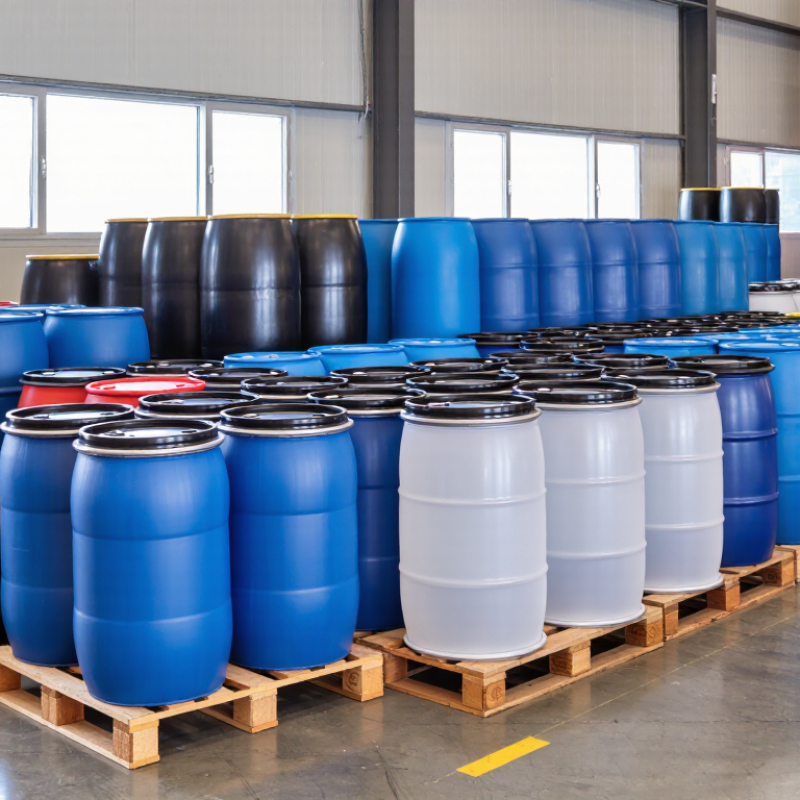
Plastic Drum Barrels: Definition, Purpose, and Basic Structure
Plastic drum barrels are rigid containers designed to store, protect, and transport liquids, powders, and granulated materials. They are usually made from high-density polyethylene because it resists impact, moisture, and many common chemicals. Common capacities range from 30 to 220 liters. The correct size depends on filling weight, handling equipment, and storage space.
A typical barrel has a cylindrical body, reinforced ribs, a top opening, and a bottom base. Closed-head models use small threaded bungs for filling and dispensing. Open-head models have a removable lid, which makes cleaning and loading easier. The lid normally includes a gasket to reduce leakage and dust entry. Some designs also use tamper-evident rings or molded handles. Small details matter. A weak gasket can cause serious problems during transport.
For global buyers, purpose should guide selection. A food-contact application needs suitable material documentation and clean manufacturing controls. Industrial use may require greater wall thickness or stronger stacking performance. During inspection, check the barrel surface for dents, stress marks, uneven molding, and sharp edges. Confirm the actual capacity, closure size, pallet fit, and empty weight. A barrel may look sturdy but still deform under heat or excessive stacking. This is an easy mistake to overlook. Specifications also need practical testing, because printed data cannot reveal every handling problem.
2026 Top Plastic Drum Barrel Types for Global Buyers - Plastic Drum Barrels: Definition, Purpose, and Basic Structure
| No. | Plastic Drum Type | Typical Nominal Capacity | Common Material | Basic Structure | Closure and Access | Typical Purpose | Handling and Storage Features | Global Buyer Considerations |
|---|---|---|---|---|---|---|---|---|
| 1 | Tight-Head Plastic Drum | 30–250 L | High-density polyethylene (HDPE) | One-piece molded body with a permanently attached top and reinforced side walls | Small threaded openings, usually with screw plugs, gaskets, or vented closures | Liquid chemicals, detergents, water-treatment products, oils, and industrial liquids | Suitable for palletizing and forklift handling when designed with compatible base features | Check chemical compatibility, closure type, wall thickness, leakage performance, and applicable UN certification |
| 2 | Open-Head Plastic Drum | 30–220 L | HDPE, sometimes with a polypropylene lid | Removable full-diameter lid with a thick cylindrical body and molded top and bottom rims | Bolt ring, lever-lock ring, or snap ring with a replaceable gasket | Powders, granules, viscous products, solids, and materials requiring easy loading or cleaning | Wide opening supports manual filling, discharge, inspection, and washing | Confirm lid seal, ring design, stacking load, reusable-cycle requirements, and internal surface cleanliness |
| 3 | Food-Grade Plastic Drum | 30–220 L | Food-contact-grade HDPE or polypropylene components | Smooth molded interior, rounded corners, and a hygienic body designed to reduce residue retention | Screw-top openings or removable lid with food-contact gasket materials | Edible oils, syrups, ingredients, liquid foods, fermentation materials, and potable-water applications | Easy to inspect and clean; colored or opaque versions can help limit light exposure | Request food-contact declarations, migration compliance, traceability information, and cleaning instructions for the destination market |
| 4 | UN-Rated Plastic Drum | 30–250 L | Performance-tested HDPE with compatible closures | Reinforced body and base designed to meet specified performance tests for regulated substances | Certified screw plugs, gaskets, and tamper-evident or vented closure options | Transport of selected dangerous goods, including certain chemicals and hazardous liquids or solids | May support international road, rail, sea, or air transport when the complete packaging system is approved | Verify the UN marking, packing group, substance compatibility, closure instructions, and destination-country transport rules |
| 5 | Stackable Plastic Drum | 60–250 L | HDPE | Vertical cylindrical body with molded feet, top recesses, or interlocking geometry for stable stacking | Tight-head openings or open-head lid systems, depending on the product design | Warehousing and transport where floor space efficiency and vertical storage are important | Designed for stable pallet or floor stacking; maximum stack height depends on load, temperature, and drum design | Ask for tested stacking load, pallet pattern, temperature limits, and recommendations for filled-drums storage |
| 6 | Nestable Plastic Drum | 30–220 L | HDPE | Tapered or specially profiled body that allows empty drums to fit inside one another | Usually a screw closure for tight-head designs or a removable lid for open-head designs | Empty-drum storage, return logistics, export packaging, and applications with high outbound packaging volume | Reduces empty return volume and can improve container utilization before filling | Compare nesting ratio, separation requirements, deformation risk, and compatibility with filling equipment |
| 7 | Conical or Tapered Plastic Drum | 30–220 L | HDPE | Tapered side wall with an open or closed top and a reinforced base designed for practical empty handling | Removable lid, screw cap, or threaded bung depending on the application | Bulk ingredients, powders, compounds, and products that benefit from easier discharge | Empty units can often nest efficiently; tapered geometry may assist product flow during unloading | Check usable capacity, center-of-gravity stability, pallet footprint, and suitability for automated filling lines |
| 8 | Reconditionable or Reusable Plastic Drum | 30–250 L | Durable HDPE with replaceable or serviceable closure components | Robust molded body designed for repeated use, inspection, cleaning, and controlled refurbishment | Reusable screw plugs, gaskets, lids, or ring closures | Closed-loop logistics, industrial liquids, non-food materials, and operations seeking reduced packaging waste | Can lower packaging consumption over multiple cycles when cleaning, inspection, and reverse logistics are properly managed | Define approved contents, cleaning validation, inspection intervals, service life, and end-of-life recycling procedures |
Note: Capacity ranges and features are typical industry specifications. Actual dimensions, load limits, closure systems, food-contact status, and UN performance certification vary by design and destination-market requirements.
Related Posts
-

Why Choose Plastic Drums for Global Shipping?
-

2026 Best Types of Plastic Drums for Global Buyers?
-

Top Uses and Benefits of Poly Drums in Industrial and Commercial Applications
-
How to Choose the Right Plastic Drum Barrel for Your Needs?
-

China Top Plastic Drum Barrel Suppliers for Global Buyers?
-
Why Choose HDPE Drums for Your Packaging Needs?



Get in touch with us,
We will contact you shortly!
What is the difference between Unline(Non-Epoxy Coated) or Lining(Epoxy Coated) Metal Drum?

What are Unline(Non-Epoxy Coated) and Lining(Epoxy Coated) drums compatible with?
What is the difference between Grade A and Grade B Metal Drum ?
What content is suitable to fill in a Recon Grade A or Grade B Drum?
What is the difference between Open Top and Close Top Drums and their usage?
What type of content are Metal or Plastic Drums suitable for?
Will there be any contamination in the reconditioned metal, plastic drums or IBC tanks?
What is the drum gauge(thickness) and weight for reconditioned metal drums?
Do you sell New Packaging Products too?
What additional services do you provide apart from selling reconditioned and new containers.?
Do you offer labelling and silkscreen on the containers ?
Are you able to ship overseas ?
Leading the Way
to Carbon Neutrality