
7 Tips for Choosing an Anti Flammable Cabinet
Choosing an Anti Flammable Cabinet is a practical safety decision, not a styling choice. The right cabinet should match the liquids stored, the amount on hand, and the conditions in the room. A mismatch can be easy to overlook: a cabinet may look sturdy while lacking suitable construction, capacity, or clear operating instructions. Small details matter. Check the label, inspect the door and latch, and consider how staff will access the cabinet during a busy shift.
This guide covers seven useful selection points, including construction, capacity, ventilation needs, placement, labeling, and routine inspection. Compare product documentation rather than relying on a bright finish or a confident sales description. Confirm that the cabinet’s stated features suit your workplace and the materials you intend to store. Then think about daily use: Can the door close fully? Are containers easy to identify? Is the area around the cabinet kept clear? These questions are not glamorous. They are useful.
A named expert quotation should be verified against a reliable source, and none was provided for this request. To avoid inventing an attribution, here is an original guiding principle for this article, not a quotation: “A cabinet protects best when its specifications and everyday use match the hazard.” Keep that in mind as you compare options. No single feature tells the whole story. A careful choice, followed by consistent inspection, can make storage safer and more dependable.
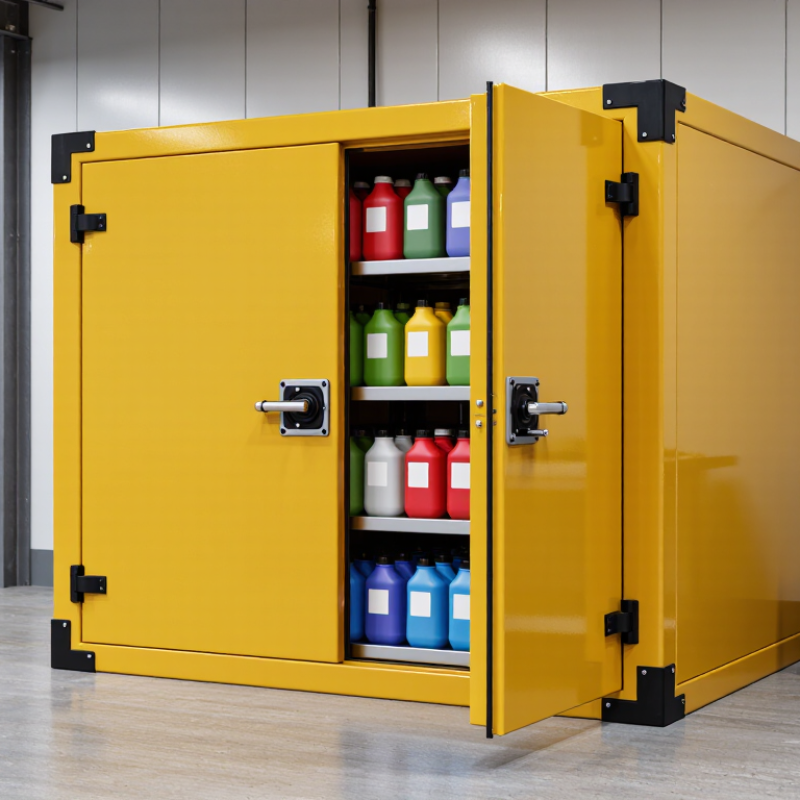
Identify the Chemicals and Storage Requirements
Before selecting a cabinet, list each liquid by product name, quantity, container size, and task. Read the Safety Data Sheet (SDS), especially Sections 7, 9, and 10: handling and storage, physical properties, and stability/reactivity. Flash point and incompatibilities matter. A solvent and an oxidizer should not share a cabinet just because both arrive in small bottles. Read the SDS.
OSHA’s 29 CFR 1910.106(d)(3)(i) gives useful capacity benchmarks for U.S. workplaces: a cabinet may hold up to 60 gallons of Category 1, 2, or 3 flammable liquids, or 120 gallons of Category 4 liquids. These are limits, not recommended fill targets. Check applicable local rules and the cabinet’s rated capacity. Leave room to remove containers safely; crowded shelves can turn routine handling into a spill risk.
Match construction and layout to actual use. Check shelf load ratings, sump capacity, door clearance, and whether containers fit upright without touching the door. NFPA 30 provides a recognized framework for flammable and combustible liquid storage; use its current edition alongside SDS guidance. Venting is not automatically safer. Follow the cabinet instructions and site fire-safety plan. Inventories change. Recheck them after process changes, and question assumptions based on old labels alone.



Get in touch with us,
We will contact you shortly!
What is the difference between Unline(Non-Epoxy Coated) or Lining(Epoxy Coated) Metal Drum?

What are Unline(Non-Epoxy Coated) and Lining(Epoxy Coated) drums compatible with?
What is the difference between Grade A and Grade B Metal Drum ?
What content is suitable to fill in a Recon Grade A or Grade B Drum?
What is the difference between Open Top and Close Top Drums and their usage?
What type of content are Metal or Plastic Drums suitable for?
Will there be any contamination in the reconditioned metal, plastic drums or IBC tanks?
What is the drum gauge(thickness) and weight for reconditioned metal drums?
Do you sell New Packaging Products too?
What additional services do you provide apart from selling reconditioned and new containers.?
Do you offer labelling and silkscreen on the containers ?
Are you able to ship overseas ?
Leading the Way
to Carbon Neutrality