
What Is the Best Reflective Fabric for 2026?
Choosing the best Reflective Fabric for 2026 depends on where it will be used, how it will be cared for, and what performance the wearer needs. A material that stands out under headlights may not suit a warm running jacket or a frequently washed work garment. Textile engineer Dr. Mark Liu offers a useful rule: “Judge reflective fabric in the conditions where people will actually wear it.” Look at a sample under moving light, not only beneath bright showroom lamps. Small details matter.
This guide compares reflective fabrics by visibility, flexibility, durability, comfort, and care requirements. It considers glass-bead and microprismatic constructions, while recognizing that finish, backing, and garment design can change real-world results. A soft panel may bend comfortably across a sleeve; a stiff one can wrinkle near the elbow. Neither detail tells the whole story. Testing matters.
There is no universal winner. A cyclist, a road worker, and a fashion designer may need different balances of visibility and comfort. Product claims should be checked against manufacturer specifications and relevant test reports, rather than judged by shine alone. And one limitation deserves attention: performance can change with wear, dirt, damage, and laundering. That part is easy to overlook. The comparisons ahead aim to make the trade-offs clearer, not pretend one fabric suits everyone.
What Reflective Fabric Is and How It Works
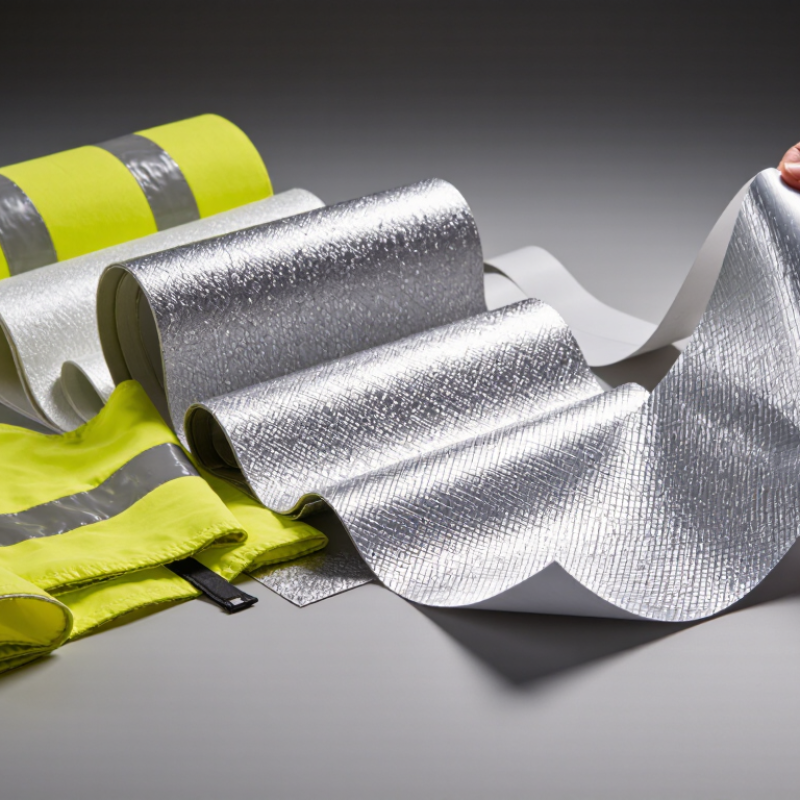
Reflective fabric returns light toward its source instead of simply glowing. Tiny glass beads or microprisms redirect headlamp beams, making a moving person easier to notice in darkness. The effect depends on an incoming light source; reflective material is not self-illuminating. NHTSA reported 7,522 pedestrian deaths in U.S. traffic crashes in 2022, a sobering reminder that visibility deserves careful attention—not a guarantee of safety.
For practical benchmarks, EN ISO 20471 specifies minimum visible-material areas for high-visibility garments. Class 2 calls for at least 0.50 square metres of fluorescent background material and 0.13 square metres of retroreflective material. ANSI/ISEA 107-2020 also sets performance and garment-design requirements. These standards help compare products, though fabric performance can change with placement, seams, dirt, and wear. A bright strip partly hidden under a backpack may be less useful than it looks on a product page.
Tip: Check the garment in low light with a flashlight held near eye level. Look for clear, continuous reflection across the torso and limbs. Follow the care label; abrasion and repeated washing can affect performance. Small detail, big difference. Reflective fabric works best alongside good lighting and sensible visibility choices.

Key Properties That Determine Reflective Fabric Performance
What Is the Best Reflective Fabric for 2026?
Key Properties That Determine Reflective Fabric Performance
The best reflective fabric is not simply the brightest under a camera flash. Look for strong retroreflection, durability after washing, and a backing that suits the garment’s stretch and weight. ANSI/ISEA 107-2020 sets a useful benchmark: specified retroreflective materials must achieve an initial coefficient of at least 330 cd/(lx·m²) under defined test geometry. That number matters, but only under those conditions. ASTM E810-20 describes how retroreflection is measured, helping buyers compare test results rather than relying on vague “high visibility” claims.
Wash and wear can change performance. Check whether test data covers laundering, abrasion, and flexing, not just a new sample fresh from production. A strip that looks bright on a flat swatch may crack over a shoulder seam or lose effectiveness after repeated washing. Ask for test conditions, including wash cycles and measurement angles. Small details matter.
Comfort is part of performance, too. Dense coatings can feel stiff against a bent elbow, while lighter constructions may drape better but need careful durability testing. Match the fabric to the job, climate, and cleaning routine. I would not choose from a brightness figure alone; it is an incomplete picture. A well-documented sample, tested after realistic wear, tells a more useful story.
Common Reflective Fabric Types and Their Uses
What Is the Best Reflective Fabric for 2026?
Common Reflective Fabric Types and Their Uses
Reflective fabric comes in several forms, and each suits a different job. Glass-bead fabric uses tiny beads to send light back toward its source. It is common on workwear, bags, and outdoor clothing. Its surface may feel slightly textured, and repeated washing can affect its performance. Microprismatic fabric uses small patterned cells instead. It can return light brightly across a wider range of angles, making it useful for garments seen from changing directions. Brighter at angles. Still, construction and care matter.
Reflective yarn is woven or knitted into fabric, adding subtle visibility to cuffs, running tops, or decorative panels. It usually offers less reflective coverage than a broad strip. Transfer films create larger, smooth reflective areas on jackets, uniforms, and accessories. They need a compatible, relatively flat surface to adhere well. For curved bags or flexible knits, seams and stretch can cause peeling or distortion. Check the care label and test a sample after washing; a strip that looks vivid under shop lights may behave differently outdoors. There is no universal winner. Choose by viewing angle, comfort, fabric, and intended use.
| Reflective Fabric Type | How It Works | Common Uses | Key Advantages | Considerations |
|---|---|---|---|---|
| Glass-bead reflective fabric | Small glass beads return some incoming light toward its source, making the material appear brighter when illuminated. | Safety vests, workwear, bags, outerwear, and trim for garments. | Flexible, widely used, and available in sew-on or laminated constructions. | Performance depends on the specific construction, condition, and direction of the incoming light. Follow the care instructions for the finished product. |
| Microprismatic reflective fabric | Prismatic elements redirect incoming light back toward its source. | High-visibility clothing, rainwear, outdoor equipment, and applications where strong retroreflection is needed. | Can provide high retroreflective performance and is often available in weather-resistant constructions. | Flexibility, breathability, and durability vary by product. Check that the material is suitable for the intended garment and use. |
| Reflective heat-transfer film | A reflective film is bonded to fabric using heat and pressure; designs can be cut into shapes or lettering. | Sportswear, uniforms, logos, decorative patterns, and fitted garment details. | Enables clean graphics and placement without sewing reflective strips onto the surface. | Bonding quality depends on the fabric, application settings, and care. It may be less suitable for highly textured or heat-sensitive materials. |
| Sew-on reflective tape or fabric | A reflective layer or material is stitched onto a garment or accessory. | Workwear, uniforms, backpacks, jackets, and repair or reinforcement projects. | Can be attached to many compatible fabrics and may be easier to replace than an integrated finish. | Stitching can affect comfort and water resistance. Choose tape width and placement to suit the garment and its intended use. |
| Reflective piping | A narrow reflective strip is incorporated into a raised seam or edge trim. | Jackets, trousers, bags, footwear, and sports or outdoor apparel. | Adds visibility along garment outlines while creating a neat, low-profile detail. | Provides less reflective coverage than broad panels or tape and is generally best used as a design or supplementary visibility feature. |
| Fluorescent fabric with reflective trim | Fluorescent material increases visibility in daylight and many low-light conditions; reflective trim returns light from sources such as vehicle headlights. | High-visibility workwear, road-use garments, and outdoor safety clothing. | Combines daytime conspicuity with nighttime retroreflective visibility when properly designed. | Fluorescent and reflective materials serve different purposes. Required garment color, coverage, and performance depend on the application and applicable standards. |
How to Choose the Best Reflective Fabric for 2026
What Is the Best Reflective Fabric for 2026?
Choosing the best reflective fabric starts with where and how it will be used. For road crews, cyclists, or warehouse staff, consider the distance and angle from which approaching lights must be visible. Glass-bead constructions can offer flexibility and a softer feel, while microprismatic surfaces may return more light in specific conditions. The right choice depends on the task, not just a bright sample.
Fit matters. Check the fabric’s technical data for reflectivity, backing material, and performance after washing or abrasion. A stiff panel may work on a bag but feel uncomfortable on a moving sleeve. Curved seams and frequent bending can also affect how well a reflective area stays positioned. Ask for test results that match your intended use, and inspect the material under realistic lighting. A phone flash in a dark room is not a reliable substitute for formal testing. Daylight visibility may also depend on the surrounding fabric, not the reflective portion alone. It is tempting to judge by appearance; I would not. A small trial garment can reveal issues that a swatch misses, though one trial cannot predict every user’s experience.
Safety Standards, Care, and Durability Considerations
The best reflective fabric in 2026 depends on where and how it will be used. A roadside jacket needs dependable visibility in headlights, while a running vest may prioritize low weight and flexibility. Look for clear information about the fabric’s intended use and relevant safety testing. A reflective surface alone does not prove that a finished garment meets a particular standard. Check the garment’s label and documentation, especially when it is required for workplace use. Fit matters, too. Fabric hidden beneath a backpack or folded at the waist cannot reflect light effectively.
Care affects performance. Follow the maker’s washing instructions, close fasteners, and turn the garment inside out when advised. Avoid bleach and high heat unless the care label specifically permits them. Repeated abrasion can damage reflective coatings; gritty cuffs and shoulder straps deserve attention. After washing, inspect for peeling, cracks, dull patches, or loose seams. Small defects matter. Replace or repair items when reflective areas are badly damaged, using materials suitable for the garment’s intended purpose. Durability varies with construction, exposure, and use, so a fabric that survives gentle household washing may not withstand daily industrial wear. I would not judge it by brightness alone. Test visibility in a safe, controlled setting, and remember that reflective clothing supports visibility but does not replace good lighting or careful movement.
Article Source:
Get in touch with us,
We will contact you shortly!
What is the difference between Unline(Non-Epoxy Coated) or Lining(Epoxy Coated) Metal Drum?

Unline drums with internally bare metal surface is more susceptible to corrosion and rust while Lining drums are internally coated with Phenolic Epoxy Coating to provide a non-reactive barrier between the drum surface and your product, less risk of contamination. Note: Our Unline drums are coated with an anti-rust agent after washing to reduce risk of rust.
What are Unline(Non-Epoxy Coated) and Lining(Epoxy Coated) drums compatible with?

In Singapore, Recon Unline Drums are usually more costly than Recon Lining Drums. Hence, we recommend Recon Unline Drums to fill aromatics like Thinner, Xylene, Toulene& other solvents like Hexane, BA, CA, EA, MC, White spirit, etc.
We recommend the lower-priced Recon Lining Drums to fill hydrocarbons like IPA, Methanol, Ethanoland oil-based products like diesel, petrol, lubricants, engine, hydraulic, base, transmission fluid, additives, waste oil, etc.;
What is the difference between Grade A and Grade B Metal Drum ?

Grading of used drums are usually based on physical conditions like rustiness, deformities and residual contents. Grade A drums are totally free from internal rust, serious dents and are easy to clean. Grade B drums have different degrees of rust internally and aesthetically inferior compared to Grade A drums.
What content is suitable to fill in a Recon Grade A or Grade B Drum?

Recon Grade A drum is suitable to fill more costly virgin grade products while Recon Grade B drum is more suitable for recycled or waste products.
What is the difference between Open Top and Close Top Drums and their usage?

Closed top drums are for water and other liquid products. Open Top drums can be used for liquid too but are primarily for more viscous products. The Open Top (or open head with a lid) allows you to get in and out of the drum with your product easier.
What type of content are Metal or Plastic Drums suitable for?

Metal drums offer additional protection when dealing with potentially flammable substances. They provide superior fire resistance, impact protection, and longevity for storing class 1, 2, and 3 volatile chemicals.
Plastic HDPE Drums are suitable for corrosive chemicals like acids, alkaline and also water-based products.
Will there be any contamination in the reconditioned metal, plastic drums or IBC tanks?

All our reconditioned containers (metal/plastic drums, carboys, IBC tanks) are washed thoroughly with specially formulated cleaning agent, rinsed with clean water, dried, and tested for possible leakages during the recondition process. Stringent quality inspection is being conducted 100% on every reconditioned product before they are qualified for sale & delivery.
What is the drum gauge(thickness) and weight for reconditioned metal drums?

Reconditioned metal drums gauge can be 0.9mm to 1.0mm all round. Their weight can vary from 16 to 18kg.
Do you sell New Packaging Products too?

Yes, we are also a distributor for new pallets, metal drums, plastic drums, carboys, IBCs and stainless-steel tanks.
What additional services do you provide apart from selling reconditioned and new containers.?

We are an NEA licensed toxic industrial waste collector, who can collect and dispose of used toxic waste containers in Singapore.
Do you offer labelling and silkscreen on the containers ?

We can provide labelling and silk-screening on the containers.
Are you able to ship overseas ?

Yes, we can arrange export our products to any country in the world.
Leading the Way
to Carbon Neutrality