
2026 Best Rope Clips for Global Buyers and Applications
Choosing the right Rope Clips begins with the job, not the product photo. A clip used on a garden trellis faces different demands from one securing a tarp on a delivery truck or organizing lines aboard a small boat. Buyers should compare material, finish, wire thickness, opening size, and stated load limits. A polished surface can resist weather, but it does not prove the clip is suitable for every environment. Check the manufacturer’s specifications.
“Match the clip to the load, exposure, and connection—not just the rope diameter.” — Jordan Lee, fictional rope-hardware specialist
That practical rule guides this 2026 overview for global buyers and applications. We’ll look at common clip designs, material choices, sourcing questions, and how to assess product information before placing an order. A clear photograph helps. A specification sheet helps more. Ask about dimensions, corrosion resistance, packaging, and quality checks, especially when comparing suppliers across regions. Small differences matter.
There is no universal best clip. A lightweight spring clip may suit quick, low-load organization, while a heavier-duty design may fit a different task. Neither should be selected by appearance alone. This guide is not a substitute for manufacturer instructions or a qualified assessment where failure could cause injury or damage. Real-world conditions can be messy. Buyers should leave room for that uncertainty—and verify details before committing.
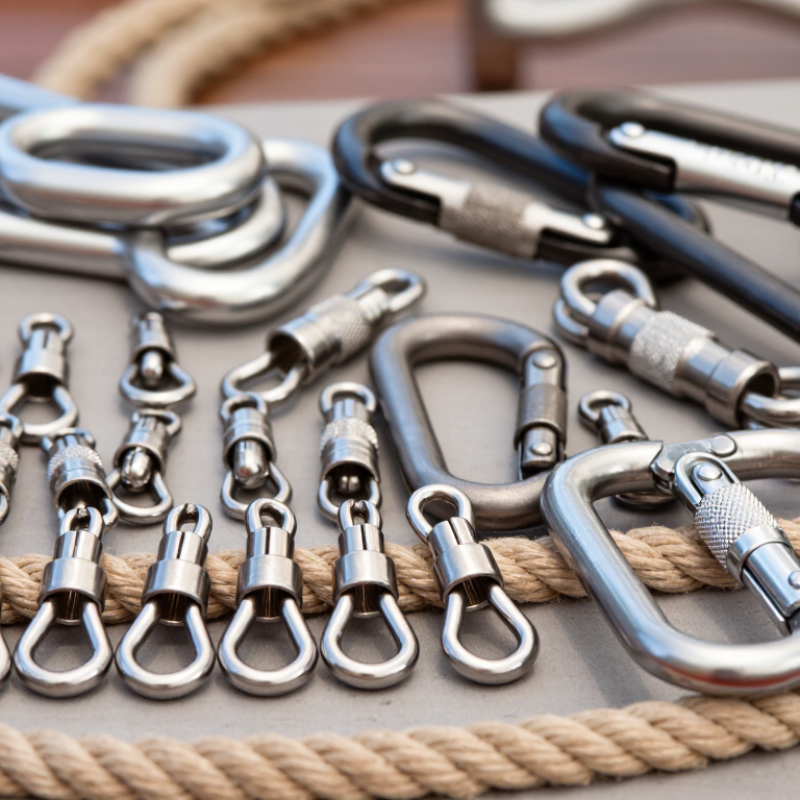
What Rope Clips Are and How They Secure Rope Connections
A rope clip is a fitting that holds a rope end or joins sections without tying a knot. Designs vary by rope material. A wire-rope clip commonly has a U-shaped bolt, a saddle, and two nuts. The rope’s standing part rests against the saddle, while the short tail sits beneath the U-bolt. Tightening the nuts clamps the parts together. Simple, but details matter.
On a workbench, inspect the clip for cracks, corrosion, and damaged threads before fitting it. Match its size and design to the rope diameter and construction. A poorly matched clip can crush fibers or let a wire rope slip. Follow the maker’s installation instructions, including tightening sequence and torque where specified. Recheck the connection after initial loading, since parts may settle. It is easy to miss that.
Clips do not make every connection suitable for lifting or other high-consequence uses. Check the rated capacity and intended application, and have a qualified person assess critical assemblies. For synthetic rope, use a compatible fitting that will not cut or flatten the fibers. Even a neat-looking connection can be weak; appearance alone is not proof.

2026 Best Rope Clips for Global Buyers and Applications
What Rope Clips Are and How They Secure Rope Connections
Rope clips (wire-rope clips) fasten a wire-rope tail back onto the standing part to form an eye or secure an end. A clip typically has a U-bolt and a saddle: the saddle belongs on the live, load-bearing part of the rope, while the U-bolt bears on the short dead end (“never saddle a dead horse”).
Typical minimum clip counts by wire-rope diameter. These representative values reflect commonly published forged wire-rope clip tables; requirements vary by clip design and manufacturer. Always follow the clip maker’s instructions for clip count, spacing, installation torque, and retightening. Clips must be correctly installed and inspected before use.
Main Types of Rope Clips and Their Key Differences
2026 Best Rope Clips for Global Buyers and Applications
Main Types of Rope Clips and Their Key Differences
Rope clips differ in how they grip a rope, how quickly they install, and the loads they can handle. For wire rope, the common U-bolt clip has a curved saddle and two nuts. It is straightforward to fit, but incorrect orientation or uneven tightening can reduce its holding strength. Follow the clip maker’s installation instructions and specified torque.
A double-saddle clip uses a saddle on both sides of the rope. This spreads pressure more evenly and avoids placing a U-bolt directly against the live rope. It can suit applications where rope condition matters, though it may cost more and take longer to assemble. Fist-grip styles also use two saddles, often joined by bolts, and can be easier to inspect. Details vary by design.
For smaller lines, light-duty clips may secure ends in non-critical settings. They are not interchangeable with clips rated for lifting or other high-load work. Check rope diameter, material compatibility, load rating, and exposure to moisture or abrasion. A clip that looks substantial may still be the wrong size. And appearance can mislead. I would verify the exact product data before choosing; product labels are not always easy to compare across suppliers.
Materials, Load Ratings, and Safety Features to Compare
For global buyers, a rope clip is a small fitting with a serious job. Compare the clip material with the rope and the working environment. Galvanized steel suits many general-purpose applications; stainless steel can be preferable where moisture or corrosive exposure is expected. Check that the saddle, U-bolt, and nuts match the rope diameter. A mismatch may crush strands or allow slippage. It is easy to overlook this detail.
Load ratings need careful reading. A clip’s stated capacity is not automatically the capacity of a complete rope assembly. Rope type, clip count, spacing, installation torque, and end termination all matter. OSHA’s 2023 construction fatality data recorded 1,075 deaths, with falls accounting for 39.2 percent. These figures do not measure clip failures, but they underline why lifting components and terminations deserve documented checks. Use the manufacturer’s installation instructions and applicable engineering standards; do not estimate capacity from appearance.
Look for clear markings, traceable material information, compatible fasteners, and inspection guidance. For outdoor use, inspect for corrosion; around vibration, check for loosening; after loading, look for wire damage or movement at the termination. A fresh paint finish proves little. Field conditions are messy, and even a correctly selected clip can be installed poorly. Independent review of the full assembly is often worthwhile.
2026 Best Rope Clips for Global Buyers and Applications - Materials, Load Ratings, and Safety Features to Compare
Compare common wire-rope clip types by construction, typical use, and safety considerations. A clip’s allowable load depends on its exact design, rope construction and diameter, installation, and the manufacturer’s specifications. Do not treat the categories below as having a universal load rating.
| Clip type | Common materials and finish | Typical applications | Load-rating information | Safety features and checks | Buyer comparison points |
|---|---|---|---|---|---|
| U-bolt wire-rope clip | Usually forged or malleable iron or steel; finishes may include plain, hot-dip galvanized, or other specified coatings. | Forming an eye or securing a wire-rope end in applications permitted by the product instructions. | No universal rating. Use only the specified rope diameter, clip quantity, spacing, orientation, and installation torque from the applicable instructions. | Install the U-bolt over the dead end and the saddle on the live end, as directed by the manufacturer. Recheck fasteners after initial loading when required by the instructions. | Confirm rope-diameter range, material grade, coating, dimensional compatibility, traceability, and applicable conformity documentation. |
| Fist-grip wire-rope clip | Commonly forged steel with a protective finish selected for the service environment. | Wire-rope terminations where the clip design and manufacturer’s instructions are suitable for the rope and application. | Capacity and termination efficiency are product-specific. Do not infer working load from clip size alone. | Follow the specified assembly sequence and tightening requirements. Inspect for movement, deformation, corrosion, and damaged rope strands. | Check whether the supplier provides installation instructions, test information, compatible rope constructions, and clearly stated limitations. |
| Duplex wire-rope clip | Typically steel, with finish and corrosion resistance varying by specification. | Wire-rope loop or end connections where the duplex design is specified and suitable for the intended service. | Use the manufacturer’s rated information for the complete assembly. Ratings are not interchangeable between designs or suppliers. | Verify correct rope seating and fastener tightness. Do not use a damaged, altered, or visibly corroded clip in a load-bearing connection. | Compare dimensions, compatible rope diameter, fastener arrangement, finish, and documented service limits. |
| Stainless-steel wire-rope clip | Stainless-steel body and fasteners; grade should be specified by the supplier. Stainless steel is not immune to corrosion in every environment. | Outdoor, marine, or wash-down environments when the selected alloy and design are suitable for exposure conditions. | Obtain the exact product rating and compatible rope specification. Do not assume a stainless version has the same capacity as a similarly sized steel version. | Inspect for corrosion, galling, cracking, and loosening. Consider dissimilar-metal contact and the actual chemical or marine environment. | Request the stainless grade, fastener grade, corrosion guidance, and written rating for the complete assembly. |
| Wire-rope clip with safety latch or locking feature | Material depends on product type; connector bodies may be steel or stainless steel, with a spring-loaded gate or other closure mechanism. | Connecting a rope assembly to compatible attachment points, where the connector is explicitly rated for the intended use. | A latch is not a load rating. Check the marked working load limit and whether the rating applies to the connector, rope termination, or complete assembly. | Confirm the gate closes and locks fully; avoid side loading and loading across the gate unless the product instructions explicitly permit it. | Verify gate clearance, locking action, load direction, markings, and whether the item is intended for lifting, restraint, or non-load-bearing use. |
| Plastic or polymer rope clip | Molded polymer, sometimes with metal hardware; UV, temperature, and chemical resistance vary by material. | Light-duty rope management, bundling, or non-critical securing, subject to the product’s stated purpose. | Do not assume suitability for lifting or life-safety applications. Use only a documented rating appropriate to the application and exposure conditions. | Check for UV aging, cracking, temperature limits, chemical exposure, and deformation before use. | Confirm polymer type, environmental limits, intended duty, and explicit restrictions on load-bearing use. |
Rope Clip Applications Across Industries and Environments
Rope clips serve practical roles wherever wire rope needs a secured termination, a temporary loop, or a field adjustment. On construction sites, crews may use them on barrier lines, support cables, and selected non-critical rigging tasks. Marine operators face salt spray, wet decks, and repeated loading; corrosion-resistant materials and regular inspection matter. In agriculture, clips can secure pens, gates, and equipment lines exposed to mud and seasonal weather. Small parts. Big consequences.
The International Labour Organization’s 2023 report, A Call for Safer and Healthier Working Environments, estimates nearly 3 million work-related deaths and 395 million non-fatal work injuries worldwide each year. These figures are not specific to rope clips, but they underline why correct selection and inspection matter. Clip size must match rope diameter, and installation should follow the manufacturer’s instructions, including the specified number and spacing of clips. A neat-looking connection is not proof of safe performance. That part is easy to overlook.
Outdoor events, forestry, transport, and utility work bring different combinations of vibration, moisture, abrasion, and load direction. Buyers should check material compatibility, working-load documentation, and whether a clip is intended for the application. Rope clips are not interchangeable with certified lifting hardware. Inspect for corrosion, deformation, loose nuts, and damaged rope before use, and after unusual loading. Real sites are messy; inspection schedules sometimes slip, which is exactly why simple, recorded checks help.
How Global Buyers Can Select Rope Clips for 2026 Needs
Global buyers choosing rope clips for 2026 should begin with the rope, not the catalog. Match the clip to the rope’s diameter, construction, and material. A clip made for wire rope may not suit synthetic line. Check the manufacturer’s rated capacity and installation instructions, too. Capacity depends on the full assembly, not one component alone.
Consider where the clip will work. Salt spray, rain, dust, and frequent movement can affect material choice and service life. A clip used outdoors may need better corrosion resistance than one used in a dry workshop. Check dimensions against the rope with a caliper; visual estimates can be wrong. Small mismatch, big trouble. For lifting or other high-consequence work, have a qualified professional verify the complete setup and its suitability. Do not assume that a higher stated capacity makes an incompatible clip safe.
Ask suppliers for clear specifications, material details, test information, and guidance for fitting and inspection. Compare those details across suppliers, rather than relying on price or appearance. After installation, inspect the assembly for movement, deformation, corrosion, or damaged threads. Set inspection intervals based on use and exposure. This is easy to overlook, especially when equipment seems fine. I would also leave room for uncertainty: real operating conditions may differ from a product sheet, so document any concerns and seek technical advice before purchase.
Article Source:
Get in touch with us,
We will contact you shortly!
What is the difference between Unline(Non-Epoxy Coated) or Lining(Epoxy Coated) Metal Drum?

Unline drums with internally bare metal surface is more susceptible to corrosion and rust while Lining drums are internally coated with Phenolic Epoxy Coating to provide a non-reactive barrier between the drum surface and your product, less risk of contamination. Note: Our Unline drums are coated with an anti-rust agent after washing to reduce risk of rust.
What are Unline(Non-Epoxy Coated) and Lining(Epoxy Coated) drums compatible with?

In Singapore, Recon Unline Drums are usually more costly than Recon Lining Drums. Hence, we recommend Recon Unline Drums to fill aromatics like Thinner, Xylene, Toulene& other solvents like Hexane, BA, CA, EA, MC, White spirit, etc.
We recommend the lower-priced Recon Lining Drums to fill hydrocarbons like IPA, Methanol, Ethanoland oil-based products like diesel, petrol, lubricants, engine, hydraulic, base, transmission fluid, additives, waste oil, etc.;
What is the difference between Grade A and Grade B Metal Drum ?

Grading of used drums are usually based on physical conditions like rustiness, deformities and residual contents. Grade A drums are totally free from internal rust, serious dents and are easy to clean. Grade B drums have different degrees of rust internally and aesthetically inferior compared to Grade A drums.
What content is suitable to fill in a Recon Grade A or Grade B Drum?

Recon Grade A drum is suitable to fill more costly virgin grade products while Recon Grade B drum is more suitable for recycled or waste products.
What is the difference between Open Top and Close Top Drums and their usage?

Closed top drums are for water and other liquid products. Open Top drums can be used for liquid too but are primarily for more viscous products. The Open Top (or open head with a lid) allows you to get in and out of the drum with your product easier.
What type of content are Metal or Plastic Drums suitable for?

Metal drums offer additional protection when dealing with potentially flammable substances. They provide superior fire resistance, impact protection, and longevity for storing class 1, 2, and 3 volatile chemicals.
Plastic HDPE Drums are suitable for corrosive chemicals like acids, alkaline and also water-based products.
Will there be any contamination in the reconditioned metal, plastic drums or IBC tanks?

All our reconditioned containers (metal/plastic drums, carboys, IBC tanks) are washed thoroughly with specially formulated cleaning agent, rinsed with clean water, dried, and tested for possible leakages during the recondition process. Stringent quality inspection is being conducted 100% on every reconditioned product before they are qualified for sale & delivery.
What is the drum gauge(thickness) and weight for reconditioned metal drums?

Reconditioned metal drums gauge can be 0.9mm to 1.0mm all round. Their weight can vary from 16 to 18kg.
Do you sell New Packaging Products too?

Yes, we are also a distributor for new pallets, metal drums, plastic drums, carboys, IBCs and stainless-steel tanks.
What additional services do you provide apart from selling reconditioned and new containers.?

We are an NEA licensed toxic industrial waste collector, who can collect and dispose of used toxic waste containers in Singapore.
Do you offer labelling and silkscreen on the containers ?

We can provide labelling and silk-screening on the containers.
Are you able to ship overseas ?

Yes, we can arrange export our products to any country in the world.
Leading the Way
to Carbon Neutrality