
How to Choose the Best Roller Conveyor Supplier in China?
Choosing the right Roller Conveyor Supplier in China requires more than comparing online prices. It demands evidence, factory experience, and careful technical questions.
The global conveyor systems market was valued at approximately USD 10.6 billion in 2023, according to Grand View Research. The report also projects steady growth through 2030, driven by warehouse automation, e-commerce, and manufacturing upgrades. MHI’s 2024 Annual Industry Report found that 83% of supply-chain professionals planned to increase technology investment. These figures suggest stronger demand for conveyors, but they do not guarantee reliable suppliers.
A practical evaluation should begin with the factory floor. Ask for photographs or videos of roller machining, welding, assembly, and load testing. Check whether the supplier calculates roller diameter, frame thickness, belt speed, and bearing capacity for your actual cartons or pallets. Request drawings, tolerance data, sample reports, and references from similar installations. A polished website is not proof.
Ash Sharma, Managing Director at Interact Analysis, has emphasized that automation is becoming a necessity rather than a luxury. That observation matters here. A capable Roller Conveyor Supplier should understand your complete material-flow process, not merely sell steel frames and rollers.
Still, no supplier is perfect. Some certificates may be outdated. Some production promises may sound better than reality. An independent factory audit, sample inspection, and clearly written warranty can expose those gaps. The cheapest quotation may become expensive when rollers wobble, motors overheat, or replacement parts arrive late. Choose measurable performance over impressive claims.
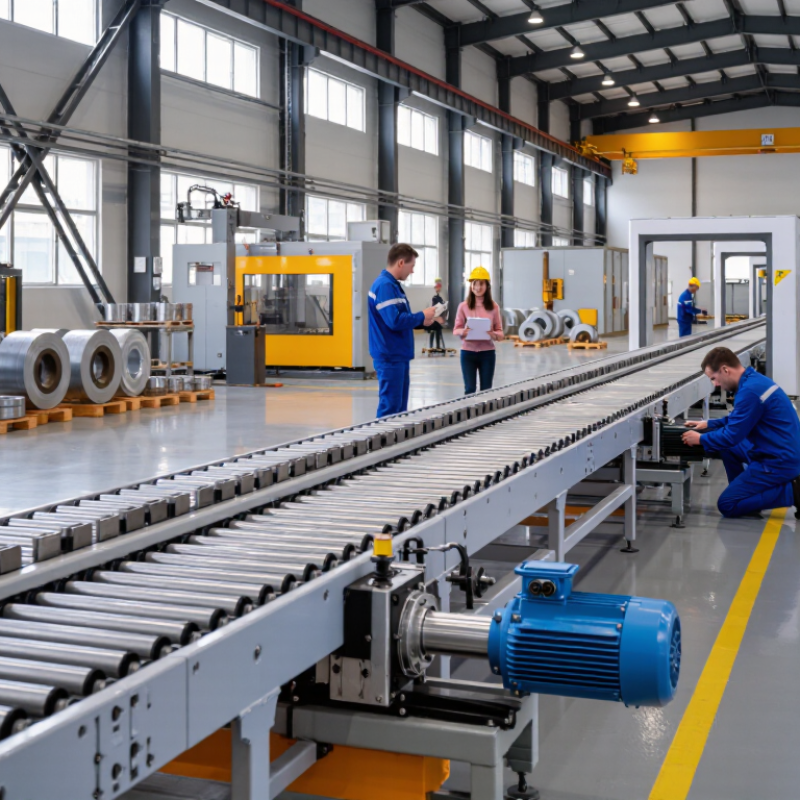
Define Your Roller Conveyor Requirements
How to Choose the Best Roller Conveyor Supplier in China?
Define Your Roller Conveyor Requirements
Start with the product, not the supplier’s catalog. Record length, width, height, weight, and package shape. Measure the heaviest load, including pallets and temporary overloads. A carton that bends between rollers needs closer spacing.
Specify throughput in cartons per minute. Also define accumulation, transfers, inclines, and operator access. Powered rollers may suit continuous movement, while gravity rollers can reduce energy use. However, gravity designs need enough slope and consistent package bottoms.
Market reports show why careful sizing matters. MarketsandMarkets valued the global conveyor system market at about USD 7.7 billion in 2023 and projected roughly 6.6% annual growth through 2028. Mordor Intelligence also identifies e-commerce, warehousing, and manufacturing as major demand drivers. These estimates cover several conveyor types, not roller units alone. Treat them as context, not a design formula.
Specify the operating environment in detail. Include temperature, dust, moisture, cleaning chemicals, noise limits, and daily operating hours. Ask for roller diameter, shaft size, frame thickness, motor rating, control voltage, and spare-parts availability. Request load tests using your actual cartons. Photos are not enough.
I have seen projects fail because the requested width matched the product, but not its turning clearance. Leave service space around motors and guards. It is easy to overlook. Ask the Chinese supplier for drawings, tolerances, inspection records, and a written acceptance checklist. The first specification is rarely perfect; revise it after a site walk and a trial load.



Get in touch with us,
We will contact you shortly!
What is the difference between Unline(Non-Epoxy Coated) or Lining(Epoxy Coated) Metal Drum?

What are Unline(Non-Epoxy Coated) and Lining(Epoxy Coated) drums compatible with?
What is the difference between Grade A and Grade B Metal Drum ?
What content is suitable to fill in a Recon Grade A or Grade B Drum?
What is the difference between Open Top and Close Top Drums and their usage?
What type of content are Metal or Plastic Drums suitable for?
Will there be any contamination in the reconditioned metal, plastic drums or IBC tanks?
What is the drum gauge(thickness) and weight for reconditioned metal drums?
Do you sell New Packaging Products too?
What additional services do you provide apart from selling reconditioned and new containers.?
Do you offer labelling and silkscreen on the containers ?
Are you able to ship overseas ?
Leading the Way
to Carbon Neutrality