
What Is an Electric Spice Grinder and How Does It Work?
An Electric Spice Grinder turns whole spices into smaller particles through a motor-driven blade or grinding mechanism. The process seems simple, but results depend on speed, chamber shape, moisture, and grinding time. A short pulse can leave coarse pepper pieces, while continuous running may create excessive heat and uneven dust. You can hear the difference: dry cumin rattles sharply, while damp cloves produce a heavier, slower sound.
Market research explains why this small appliance deserves closer attention. Grand View Research reports continued growth in the global spices market, driven partly by home cooking and demand for fresher flavor. Euromonitor International also identifies countertop food-preparation appliances as an important household category. These reports do not prove that every kitchen needs an electric grinder. They show a broader shift toward convenient, controlled preparation at home.
Inside the appliance, an electric motor transfers torque to rotating blades or burrs. Blades chop quickly, while burr-style systems crush spices more gradually. The lid, bowl, and airflow influence how evenly particles move. Coffee-grinder research from the Specialty Coffee Association also highlights particle consistency as a major factor in extraction and flavor. The same principle applies to spices, although the ideal texture varies by recipe. Curry powder needs fine particles. Crushed pepper should retain visible fragments.
No grinder is perfect. A practical test involves weighing spices, pulsing for equal intervals, and checking the texture through a fine sieve. Clean the chamber carefully afterward. Strong aromas linger. This guide examines how an Electric Spice Grinder works, what its parts actually do, and where convenience may hide compromises.
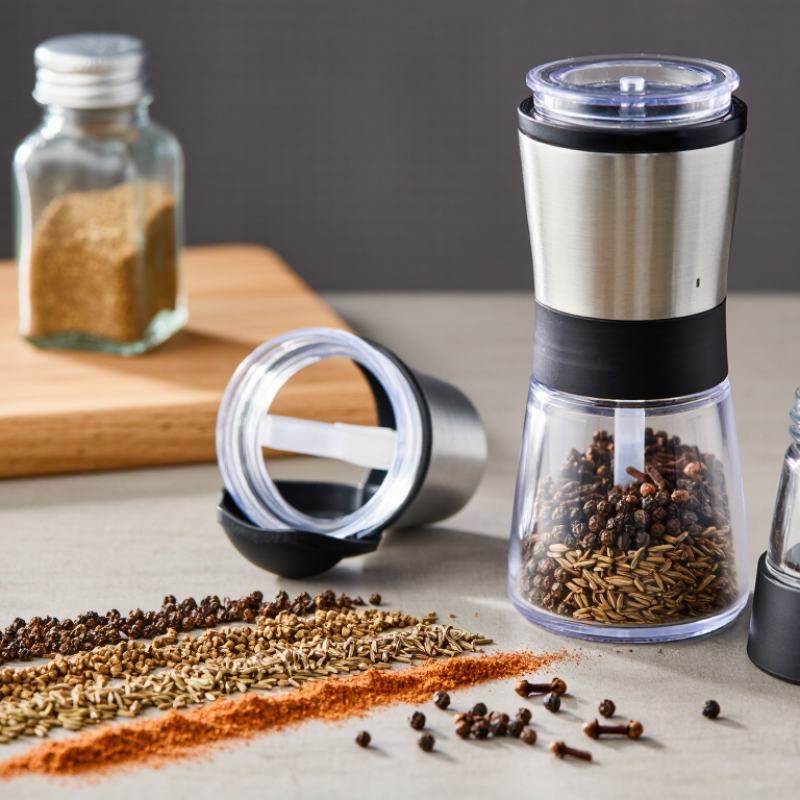
What Is an Electric Spice Grinder?
An electric spice grinder is a compact kitchen appliance that crushes dry spices with a motor-driven blade. It turns whole peppercorns, cumin seeds, cloves, and dried herbs into smaller particles within seconds. Unlike a hand mortar, it requires little physical effort and produces a more consistent texture. That simple purpose matters.
When you press the lid or power button, electricity activates a small motor beneath the grinding chamber. The motor spins a sharp blade at high speed. As the blade moves, spices hit its edges and the chamber walls, gradually becoming powder or coarse flakes. Short pulses usually provide better control. Holding the button too long can create unwanted heat and uneven results. I have found that sound changes as the spices become finer, which helps guide timing.
Most electric spice grinders have a removable cup, a transparent lid, and a basic safety lock. The lid allows you to watch the texture without opening the chamber. Dry ingredients generally grind best. Moist ingredients may stick, smear, or strain the motor. Cleaning also deserves attention because strong aromas can remain after grinding. I once assumed a quick wipe was enough. In practice, residue can affect the next batch. A small brush and a completely dry chamber are more reliable. Some grinders are powerful, but they are not designed for unlimited capacity or continuous operation.

Key Components and Their Functions
An electric spice grinder converts electrical energy into controlled rotational force. Its key components determine speed, texture, safety, and cleaning performance. The motor drives a metal shaft through a coupling, while a blade or burr set breaks spices inside the grinding chamber. Blades work quickly, but burrs usually offer more consistent particle sizes. The chamber wall guides the ingredients back toward the cutting area.
A pulse switch controls short grinding bursts and limits overheating. Many models include a lid interlock, which prevents operation when the cover is open. Thermal protection can stop the motor when friction raises internal temperature. This matters because excessive heat may reduce the aroma of delicate spices. Grand View Research’s 2024 Spices Market report estimated the global market at about 23 billion U.S. dollars in 2024, showing why reliable small-scale processing matters. The FDA Food Code 2022 also emphasizes cleanable, food-contact surfaces. Stainless steel is practical, but seams and trapped powder remain weak points. The design is efficient, not perfect.
Tips: Use short pulses, not continuous pressure. Fill the chamber only partly, leaving room for circulation. Check the shaft and lid seal after each use. A dry brush removes residue better than water near the motor housing. My practical concern is often overlooked: inconsistent particle size can change extraction, seasoning strength, and cooking time. That small difference deserves attention.
What Is an Electric Spice Grinder and How Does It Work?
Typical Rotational Speed Ranges of Key Grinding Systems
An electric spice grinder uses an electric motor to rotate blades or burrs, breaking spices into smaller particles. Blade grinders commonly operate at high speeds of about 20,000–30,000 rpm, while burr systems rotate more slowly, typically around 300–500 rpm, to produce more controlled particle sizes. The motor provides torque, the grinding mechanism processes the spices, the container holds the ingredients, and the switch or control circuit manages operation.
The speed ranges shown are typical engineering ranges for household grinding mechanisms; actual operating values vary by design and load.
How an Electric Spice Grinder Works Step by Step
What Is an Electric Spice Grinder and How Does It Work?
An electric spice grinder uses a small motor to turn sharp blades inside a covered grinding chamber. When you press the button, electricity reaches the motor. The motor spins the blade at high speed. Whole spices then strike the blade and chamber walls, breaking into smaller pieces. Hard seeds may need several short pulses. The texture changes from coarse flakes to fine powder as grinding continues.
The process is simple but requires attention. Add dry spices without filling the chamber completely. A little space helps the pieces move evenly. Secure the lid, then press the control briefly. Release it and check the texture. Repeat until the result looks suitable for your recipe. Continuous grinding can create heat, which may reduce the freshness of delicate spices. I sometimes stop too late, so checking often is worth the extra few seconds.
Tips: Use short pulses for better control. Keep the chamber dry and clean it after use. Grind only small batches for a more even result. Avoid touching the blade, even when it appears still. Uneven pieces can remain, especially with tough spices. Sifting or stirring may help, although it adds one more step.
What Is an Electric Spice Grinder and How Does It Work?
| Step | What Happens | Main Component | Typical Result | Practical Consideration |
|---|---|---|---|---|
| 1. Preparation | Whole spices are placed inside the grinding chamber. The chamber should not be filled beyond its recommended capacity. | Grinding bowl or chamber | Spices are positioned around the cutting or grinding mechanism. | Large, hard pieces may need to be broken into smaller pieces before grinding. |
| 2. Power Activation | Pressing the operating button sends electricity to the motor. | Power cord, battery, switch, or control button | The motor begins rotating the internal mechanism. | Many compact models operate only while the button is pressed to improve control and safety. |
| 3. Motor Rotation | The electric motor converts electrical energy into rotational motion. | Electric motor and drive shaft | Mechanical energy is transferred to the blade or burr system. | Motor speed, load, and grinding duration influence the final texture and heat buildup. |
| 4. Initial Breaking | The rotating mechanism strikes or compresses whole spices, breaking them into smaller fragments. | Stainless-steel blade or grinding burrs | Large seeds and dried pieces become coarse particles. | Blade systems usually work quickly, while burr systems generally offer more consistent particle sizing. |
| 5. Repeated Grinding | Particles move around the chamber and pass through the cutting area repeatedly as the motor continues running. | Blade, burr, chamber walls, and rotating airflow | Coarse fragments gradually become a finer powder. | Short pulses can help distribute particles and reduce excessive heating. |
| 6. Texture Control | The user stops the motor when the desired texture is reached. | Push-button control, timer, or preset control | Possible textures include coarse cracked spice, medium granules, or fine powder. | Longer operation normally produces a finer grind, but the result also depends on spice type and quantity. |
| 7. Motor Stop | Releasing the button or switching off the appliance cuts power to the motor. | Switch and internal safety circuit | The blade or burr slows and stops. | Wait until all moving parts have stopped before opening the lid. |
| 8. Separation and Use | The lid is removed and the ground spice is transferred to a recipe, container, or storage jar. | Lid, removable bowl, or dispensing opening | Freshly ground spice is ready for immediate use. | A dry, clean container helps preserve aroma and prevents contamination between different spices. |
| 9. Cleaning | Residual particles are removed from the chamber and grinding mechanism. | Removable bowl, brush, or wipe-clean surfaces | The grinder is prepared for the next batch. | Electrical parts should not be immersed in water unless the product instructions specifically allow it. |
An electric spice grinder is a small appliance that uses an electric motor to break down whole spices into coarse, medium, or fine particles. Grinding performance depends on the spice’s hardness, moisture level, quantity, motor power, grinding mechanism, and operating time.
Types of Spices Suitable for Electric Grinding
What Is an Electric Spice Grinder and How Does It Work?
An electric spice grinder uses a fast motor, blade, or burr to break dried ingredients into smaller particles. Its best results come from hard, dry spices with low moisture. Black peppercorns, cumin, coriander, fennel, mustard seeds, cardamom seeds, cloves, and dried chili pieces grind efficiently. Small cinnamon fragments and grated nutmeg also work, but they may strain compact motors. Go slowly.
A 2024 Grand View Research report estimated the global spices market at about USD 22.8 billion in 2023, with projected annual growth near 6.5% through 2030. That growth reflects wider home use of whole spices and freshly ground seasonings. Whole spices usually retain stronger aroma because grinding exposes their volatile oils. However, oily ingredients such as sesame, nuts, and some seed blends can create a sticky paste. Fresh ginger, garlic, herbs, and wet chilies are unsuitable for ordinary electric grinders. They need different equipment and cleaning methods. I prefer two-second pulses, small batches, and a brief cooling pause. Otherwise, heat can dull delicate aromas. I still sometimes grind too much, then regret the stale powder a week later. A coarse setting suits pepper and coriander for visible texture. A finer setting works better for soups, marinades, and baking. Always check the grinder’s capacity before adding dense spices.
Safe and Effective Use of an Electric Spice Grinder
What Is an Electric Spice Grinder and How Does It Work?
An electric spice grinder uses a small motor to rotate sharp blades at high speed. These blades break dried peppercorns, cumin, seeds, and other hard spices into smaller particles. Most models work with a sealed cup, a lid, and a push-button or pulse switch. Short pulses usually create better control than continuous grinding. They also reduce heat buildup, which can weaken delicate aromas.
Safe and Effective Use of an Electric Spice Grinder
Use only dry, food-safe ingredients approved by the grinder’s instructions. Moist foods may clog the blade area or strain the motor. Keep the grinder on a stable, dry surface, and check the cord before every use. Stop immediately if you notice sparks, burning smells, unusual noise, or a hot housing. Unplug it before removing stuck material or cleaning the cup.
- Keep the lid secured.
- Do not overfill.
A practical load is often one-third to one-half of the cup, but the manual has priority. Pulse for a few seconds, pause, and inspect the texture. Never place fingers near the blade, even when it appears stationary.
The U.S. National Fire Protection Association reported that cooking caused 53% of reported home structure fires from 2017 to 2021. A grinder is not a stovetop, but that data supports careful heat and electrical habits. The Electrical Safety Foundation International also recommends replacing damaged cords instead of repairing them casually.
I still find rushed cleaning easy to underestimate; fine spice dust can remain under the blade assembly. Use a dry brush, and never immerse the motor housing.
Article Source:
Get in touch with us,
We will contact you shortly!
What is the difference between Unline(Non-Epoxy Coated) or Lining(Epoxy Coated) Metal Drum?

Unline drums with internally bare metal surface is more susceptible to corrosion and rust while Lining drums are internally coated with Phenolic Epoxy Coating to provide a non-reactive barrier between the drum surface and your product, less risk of contamination. Note: Our Unline drums are coated with an anti-rust agent after washing to reduce risk of rust.
What are Unline(Non-Epoxy Coated) and Lining(Epoxy Coated) drums compatible with?

In Singapore, Recon Unline Drums are usually more costly than Recon Lining Drums. Hence, we recommend Recon Unline Drums to fill aromatics like Thinner, Xylene, Toulene& other solvents like Hexane, BA, CA, EA, MC, White spirit, etc.
We recommend the lower-priced Recon Lining Drums to fill hydrocarbons like IPA, Methanol, Ethanoland oil-based products like diesel, petrol, lubricants, engine, hydraulic, base, transmission fluid, additives, waste oil, etc.;
What is the difference between Grade A and Grade B Metal Drum ?

Grading of used drums are usually based on physical conditions like rustiness, deformities and residual contents. Grade A drums are totally free from internal rust, serious dents and are easy to clean. Grade B drums have different degrees of rust internally and aesthetically inferior compared to Grade A drums.
What content is suitable to fill in a Recon Grade A or Grade B Drum?

Recon Grade A drum is suitable to fill more costly virgin grade products while Recon Grade B drum is more suitable for recycled or waste products.
What is the difference between Open Top and Close Top Drums and their usage?

Closed top drums are for water and other liquid products. Open Top drums can be used for liquid too but are primarily for more viscous products. The Open Top (or open head with a lid) allows you to get in and out of the drum with your product easier.
What type of content are Metal or Plastic Drums suitable for?

Metal drums offer additional protection when dealing with potentially flammable substances. They provide superior fire resistance, impact protection, and longevity for storing class 1, 2, and 3 volatile chemicals.
Plastic HDPE Drums are suitable for corrosive chemicals like acids, alkaline and also water-based products.
Will there be any contamination in the reconditioned metal, plastic drums or IBC tanks?

All our reconditioned containers (metal/plastic drums, carboys, IBC tanks) are washed thoroughly with specially formulated cleaning agent, rinsed with clean water, dried, and tested for possible leakages during the recondition process. Stringent quality inspection is being conducted 100% on every reconditioned product before they are qualified for sale & delivery.
What is the drum gauge(thickness) and weight for reconditioned metal drums?

Reconditioned metal drums gauge can be 0.9mm to 1.0mm all round. Their weight can vary from 16 to 18kg.
Do you sell New Packaging Products too?

Yes, we are also a distributor for new pallets, metal drums, plastic drums, carboys, IBCs and stainless-steel tanks.
What additional services do you provide apart from selling reconditioned and new containers.?

We are an NEA licensed toxic industrial waste collector, who can collect and dispose of used toxic waste containers in Singapore.
Do you offer labelling and silkscreen on the containers ?

We can provide labelling and silk-screening on the containers.
Are you able to ship overseas ?

Yes, we can arrange export our products to any country in the world.
Leading the Way
to Carbon Neutrality